

Maharashtra positions itself as a national leader in climate action, with pledges covering renewable energy, flood resilience, and agriculture support for vulnerable communities.
A Historic Step for India’s Climate Agenda
India’s financial capital made history on February 17, 2025, as Maharashtra launched the country’s first-ever Mumbai Climate Week — an initiative designed to convert climate conversations into concrete, on-the-ground action. The event, inaugurated by Chief Minister Devendra Fadnavis, drew together a powerful assembly of national ministers, urban administrators, international representatives, and environmental stakeholders, signaling that climate action in India is rapidly moving from policy papers to implementation priorities.
For the millions of farmers, coastal residents, and urban workers whose livelihoods are increasingly shaped by erratic weather, the occasion carries significant weight.

Why Mumbai? Understanding the Backdrop
Mumbai is among Asia’s most climate-exposed megacities. Situated along the Arabian Sea, it faces a dangerous combination of rising sea levels, intensifying monsoon flooding, and urban heat effects. These are not distant projections — they are current realities. Seasonal flooding regularly disrupts rail networks, submerges homes, and brings commerce to a standstill.
Beyond the city, Maharashtra’s agricultural heartland — home to millions of smallholder farmers — is experiencing its own climate pressures. Unseasonal rainfall has become a recurring nightmare, destroying standing crops and post-harvest produce alike. Meanwhile, prolonged dry spells are stretching the limits of water availability across rain-fed farming districts. Heatwaves, once exceptional events, now arrive with troubling regularity, affecting construction laborers, street vendors, and open-field workers most severely.
Against this backdrop, the launch of Mumbai Climate Week reflects a recognition that climate change is no longer a future risk — it is an active governance crisis.
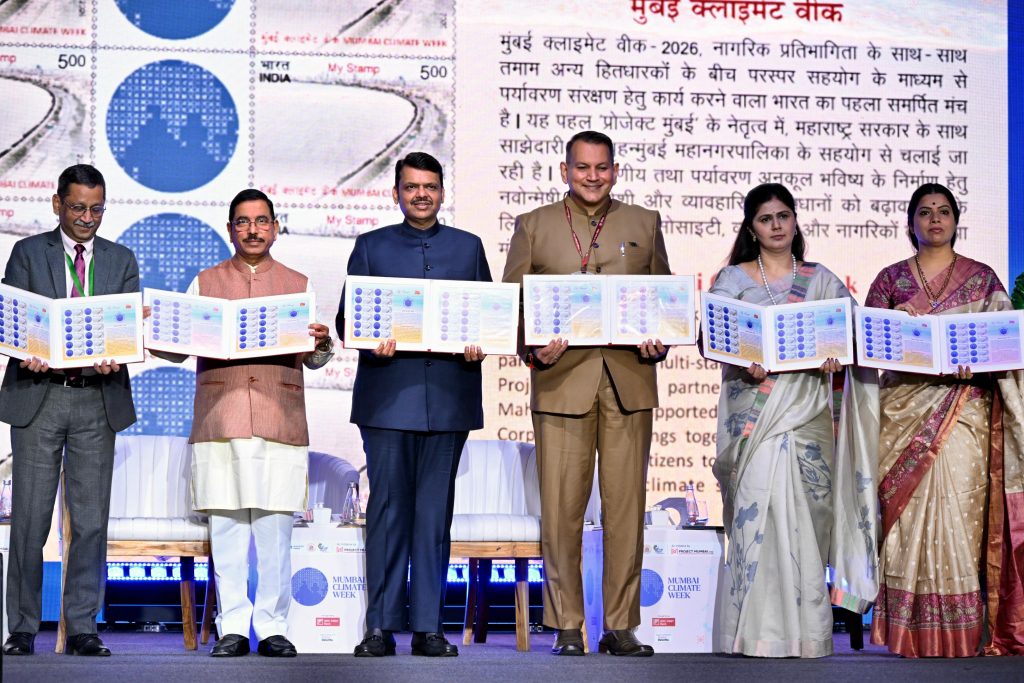
Key Announcements and Developments
Chief Minister Fadnavis outlined a multi-pronged climate agenda for Maharashtra that spans energy, urban infrastructure, and rural development. Headlining the state’s ambitions is a commitment to sourcing more than 50 percent of its energy from green sources by 2030, with priorities placed on clean hydrogen technology, electric mobility, biofuels, and low-carbon infrastructure development.
Crucially, Fadnavis reframed climate action not as a compliance burden but as an economic engine. With global investment flows increasingly favoring sustainable markets, the Chief Minister argued that states which move fast on decarbonization will attract both capital and skilled talent. Maharashtra, he insisted, intends to be at the front of that race.
Union Minister for New and Renewable Energy Pralhad Joshi, Maharashtra Environment and Climate Change Minister Pankaja Munde, and Martin Krause, Director of the United Nations Environment Programme, were among the dignitaries present, adding both national and international weight to the proceedings.
Environmental Dimensions: Cities, Coasts, and Climate Finance
A critical theme running through the event was the need for scalable climate finance. Acknowledging that state budgets alone cannot fund the transition required, the Chief Minister called on multilateral financial institutions and private investors to participate through blended finance models and risk-sharing mechanisms. He proposed that Mumbai — already a financial powerhouse — could evolve into a major global hub for climate-related investment.
Environmental equity was also raised prominently. Fadnavis stressed that developing nations cannot be compelled to sacrifice developmental aspirations at the altar of climate targets. Climate justice, he argued, must be a foundational principle in global negotiations, ensuring that countries like India can pursue growth while responsibly managing their environmental footprint.
On the urban front, flood management systems are being upgraded, and large-scale infrastructure projects in the Mumbai Metropolitan Region are now being designed with both sustainability benchmarks and disaster resilience built in from the planning stage.
Agricultural and Farmer Impact: The Rural Stakes
For Maharashtra’s farming communities, the announcements carry practical implications. The state is advancing climate-resilient agriculture as a strategic priority — an approach that involves developing crop varieties and farming practices capable of withstanding shifting rainfall calendars and water shortages.
Efficient water management systems are central to this effort, particularly in water-stressed districts where groundwater depletion has accelerated. The promotion of technology-driven rural value chains is also on the agenda, aimed at helping farmers reduce post-harvest losses and better navigate volatile weather patterns.
Heatwave protection for outdoor agricultural workers, support during unseasonal rain events, and improved rural forecasting systems are all elements being woven into the broader climate resilience framework. While specific funding allocations were not detailed at the inauguration, the policy direction sends a clear message: rural Maharashtra is part of the climate solution, not just a victim of climate change.
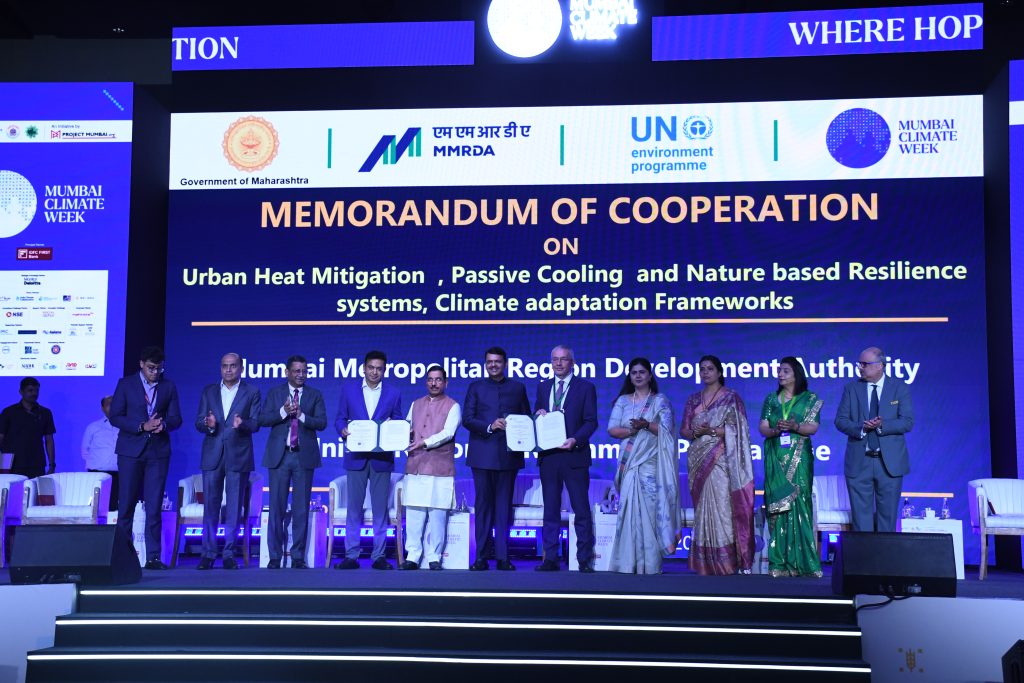
The Chief Minister of Devendra Fadnavis, Union Minister For New and Renewable Energy Mr. Prahallad Joshi, Environment Minister Mrs. Pankaja Munde, MMRDA commissioner Mr. Sanjay Mukharjee
From Declarations to Deliverables
One of the most pointed remarks of the inauguration came from Fadnavis himself, who cautioned against events that generate declarations without implementation. Mumbai Climate Week, he said, must be measured not by the quality of its speeches but by the investable projects and actionable partnerships it produces.
For farmers battling crop losses, fisherfolk facing unpredictable seas, and city dwellers navigating flooded streets, that standard could not be more relevant. As Maharashtra steps into a leadership role on climate action, the credibility of its commitments will ultimately be judged in fields, neighborhoods, and communities — not in conference halls.